The Hidden Burden: Musculoskeletal Disorders and Back Pain Among Operating Room Nurses in the US, Canada, and Europe

Operating room (OR) nurses, also known as perioperative nurses, play a critical role in surgical procedures, often involving prolonged standing, awkward postures, and manual patient handling tasks such as positioning, transferring, and lifting. These demands contribute significantly to work-related musculoskeletal disorders (MSDs), including back pain and injuries, which are among the most common occupational health issues in healthcare. This article synthesizes recent data (from 2020-2026) on the prevalence of these conditions, focusing on the United States (US), Canada (CA), and the European Union (EU). Drawing from systematic reviews, meta-analyses, and cross-sectional studies, it highlights the urgent need for ergonomic interventions to mitigate these risks.
![Figure 1.Annual prevalence of WMSDs in different anatomical sites by prevalence rate (adopted from ref. [33]).](https://cdnintech.com/media/chapter/1174469/1751012786-215571996/media/F1.png)
The image above illustrates the overall prevalence of MSDs in nurses, showing how back-related issues dominate across body regions.
Global Context and Common Risk Factors
Globally, MSDs affect a substantial portion of OR personnel, with prevalence rates ranging from 58-90% annually.1 Lower back pain is the most prevalent, often exceeding 60%, due to factors like static postures during surgeries, manual lifting of patients (e.g., using sheets for transfers), and repetitive bending.2 A meta-analysis of over 3,500 perioperative nurses reported pooled prevalences of 62% for lower back, 47% for knees, and 44% for shoulders, with patient positioning identified as a key contributor.2 These disorders not only cause chronic pain but also lead to absenteeism, reduced productivity, and early retirement, imposing significant economic costs on healthcare systems.
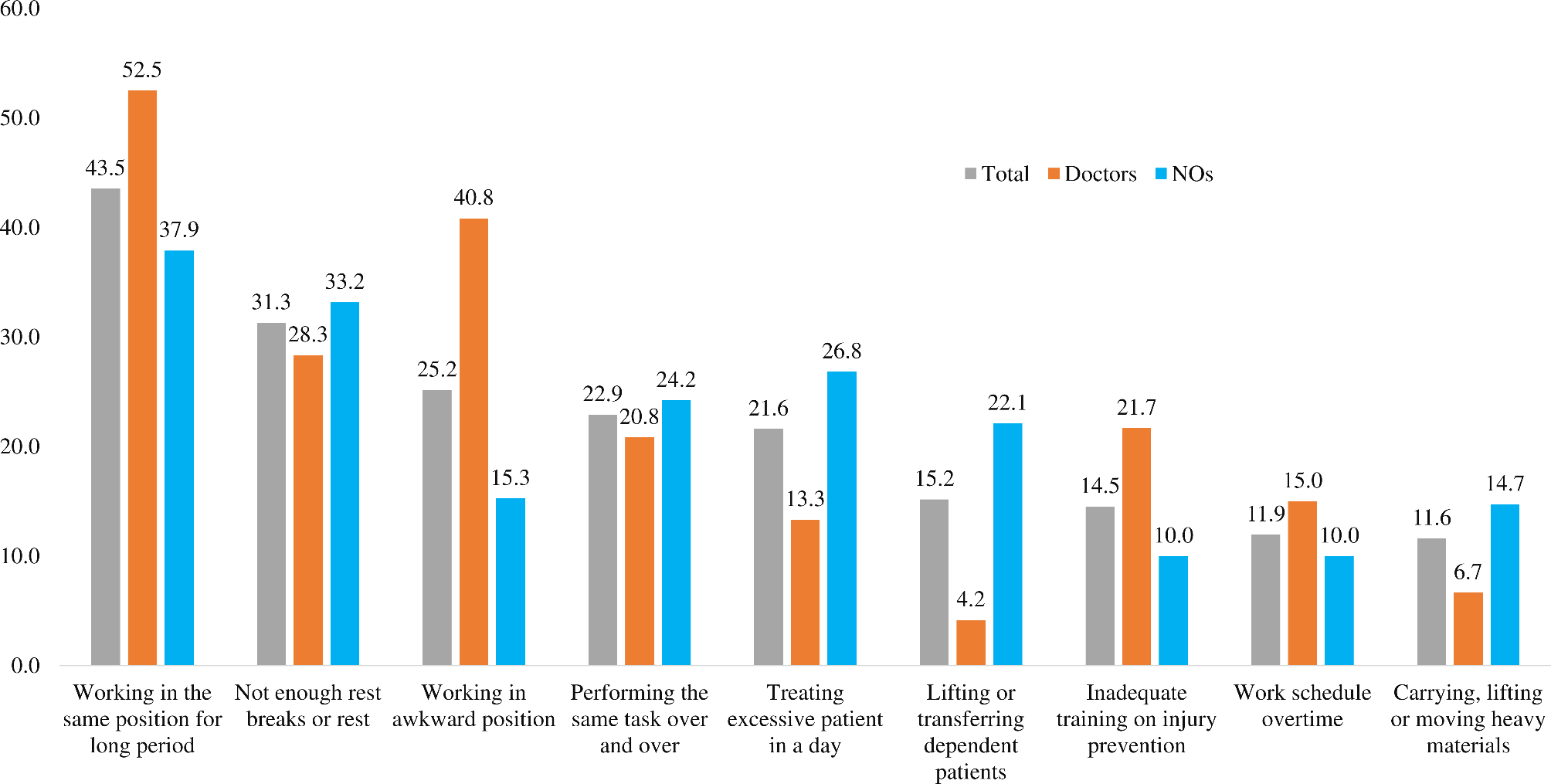
This chart depicts MSD prevalence among doctors and nursing officers, emphasizing back and neck issues common in OR settings.
Prevalence in the United States
In the US, MSDs among perioperative nurses are alarmingly high, often linked to high patient volumes and limited access to assistive devices. A national survey indicated that nearly 50% of nonfatal occupational injuries in perioperative settings are musculoskeletal, with back injuries comprising over 25%.2 Lower back pain affects 53-84% of OR nurses annually, with patient handling tasks like lateral transfers and prone positioning responsible for 35% and 23% of reported injuries, respectively.3 Broader data from the Bureau of Labor Statistics shows that these issues contribute to high workers’ compensation claims, averaging $15,600 per case.4 Safe patient handling programs have shown promise, reducing injury rates by 65-71% in some facilities.
Prevalence in Canada
Canadian data on OR-specific MSDs is more limited but aligns with North American trends, showing elevated risks in high-demand environments. Annual MSD prevalence among nurses is approximately 77%, with lower back pain at 59.5%.5 A study of vascular surgeons and trainees (relevant to OR contexts) reported 78% low back symptoms.4 Overall, back pain affects 50-60% of shift-working nurses, exacerbated by prolonged scrub shifts and manual positioning.6 Economic impacts are notable, with indirect costs estimated at 4.2% of GDP, highlighting the need for province-wide ergonomic initiatives.
Prevalence in the European Union
In the EU, MSDs are the most common work-related health problem, with healthcare workers reporting backache at 47%—ranking among the highest sectors.7 Among nurses, the overall annual prevalence is 87.8%, with lower back at 61.4%, neck at 49.9%, and upper back at 46.3%.38 Perioperative nurses face even higher rates due to operating room specifics, with lower back pain exceeding 60% in meta-analyses.9 EU-OSHA data notes that these disorders lead to significant absenteeism, with physical and temporal risks like low temperatures and repetitive tasks amplifying the issue.7
This video highlights historic poor work postures and ergonomics during patient positioning and patient handling processes, a common risk factor for back injuries in OR nurses.
Mitigation Strategies and Future Directions
To address these high prevalence rates, interventions such as combined patient handling and positioning platforms, ergonomic training, and team-based lifts are essential. Organizations like AORN in the US and EU-OSHA advocate for these measures to protect staff and improve patient safety. Future research should focus on longitudinal studies and the impact of innovative technologies.
Fortunately, the rise of advanced surgical positioning platforms—such as those we’ve pioneered nearly a decade ago—is rapidly transforming the industry by prioritizing the safety and protection of both patients and the dedicated surgical teams who care for them.
Our surgical positioning solutions foster consistent, reproducible clinical practices while integrating seamlessly with complementary technologies, such as mechanical patient lifts and powered air-assisted transfer systems. This goes far beyond basic lateral transfers, enabling comprehensive safe patient handling throughout the entire perioperative workflow—resulting in reduced ergonomic strain for staff and uncompromised precision in patient positioning and surgical outcomes.
As a clinically founded company led by experienced perioperative professionals, we’ve dedicated ourselves to challenging decades-old, entrenched patient handling and positioning practices with innovations born directly from real-world operating room realities.
We’ve seen it repeatedly: when faced with ergonomic risks, surgical teams naturally prioritize their own safety, sometimes at the expense of ideal patient positioning and clinical results. Our platforms eliminate this difficult trade-off by delivering superior protection and efficiency for caregivers and patients alike.
We were the first to patent integrated patient handling and positioning platforms with our FPLS®, Hadron, and Genesis product lines, setting a new industry benchmark. While a few competitors have since introduced perceived similar concepts in response to our innovations, their solutions often reflect a shallower understanding of the daily challenges perioperative teams face. Consequently, those alternatives fall short in design robustness, durability, and, most importantly, the ability to fully resolve the core clinical and ergonomic issues our technology was engineered to address from the very beginning.
What truly differentiates us is our deep-rooted clinical expertise. This not only guides superior product design, but also empowers us to educate and guide customers toward safer, more reliable processes that are designed to evolve current patient handling and positioning practices, helping them break free from outdated habits that have persisted far too long in operating rooms worldwide.
For us, this goes far beyond market share or marketing. Our mission is to fundamentally transform the industry by developing solutions that balance exceptional patient safety with meaningful protection for the surgical staff who deliver that care every day. The fact that our largest competitors are now beginning to mimic our products only affirms our profound impact on the industry as a true disruptor.
If you’re ready to elevate your standard of care, please reach out to schedule a demonstration or trial.
Bibliography
The following sources were used in this article:
- Tavakkol et al. (2020). The global prevalence of musculoskeletal disorders among operating room personnel: A systematic review and meta-analysis. Clinical Epidemiology and Global Health. Link
- Clari et al. (2021). Prevalence of musculoskeletal disorders among perioperative nurses: a systematic review and META-analysis. BMC Musculoskeletal Disorders. Link
- Heidari et al. (2025). Work-Related Musculoskeletal Disorder Prevalence by Body Area Among Nurses in Europe: Systematic Review and Meta-Analysis. Journal of Functional Morphology and Kinesiology. Link
- Tavakkol et al. (2020). A Multidisciplinary Focus Review of Musculoskeletal Disorders Among Operating Room Personnel. Journal of Multidisciplinary Healthcare. Link
- Du et al. (2023). Prevalence of Work-Related Musculoskeletal Disorders among Nurses: A Meta-Analysis. Iranian Journal of Public Health. Link
- Kalkan et al. (2024). The Impact of Work-Related Musculoskeletal Pains on Routine Tasks Among Operating Room Nurses: A Multicenter Cross-Sectional Study. Pain Management Nursing. Link
- EU-OSHA (2024). Prevention strategies for MSDs in the healthcare sector. OSHwiki. Link
- Heidari et al. (2025). (Duplicate reference to source 3 for European nurse-specific data)
- Clari et al. (2021). (Duplicate reference to source 2 for perioperative meta-analysis)
Related Posts

The Infinitus Advantage
Please take just five minutes to discover how we stand apart—and how your legacy surgical…

Here is a Sneak Peak of Our Upcoming Pneuma® Genesis Infinity Platform!
https://vimeo.com/1127575396?fl=pl&fe=sh Please reach out to your local surgical care representative, or contact us at infinitusmedical.com…

Here Is a Sneak Peak of Our New Luna SP®
Come see how our newest supine comfort pad can be accessorized for your surgical procedural…